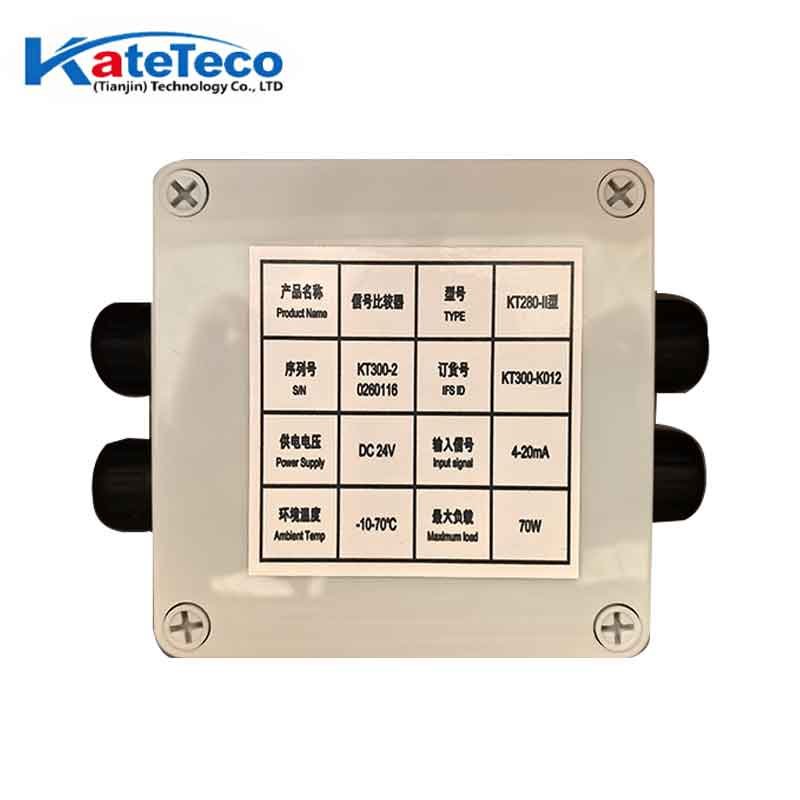
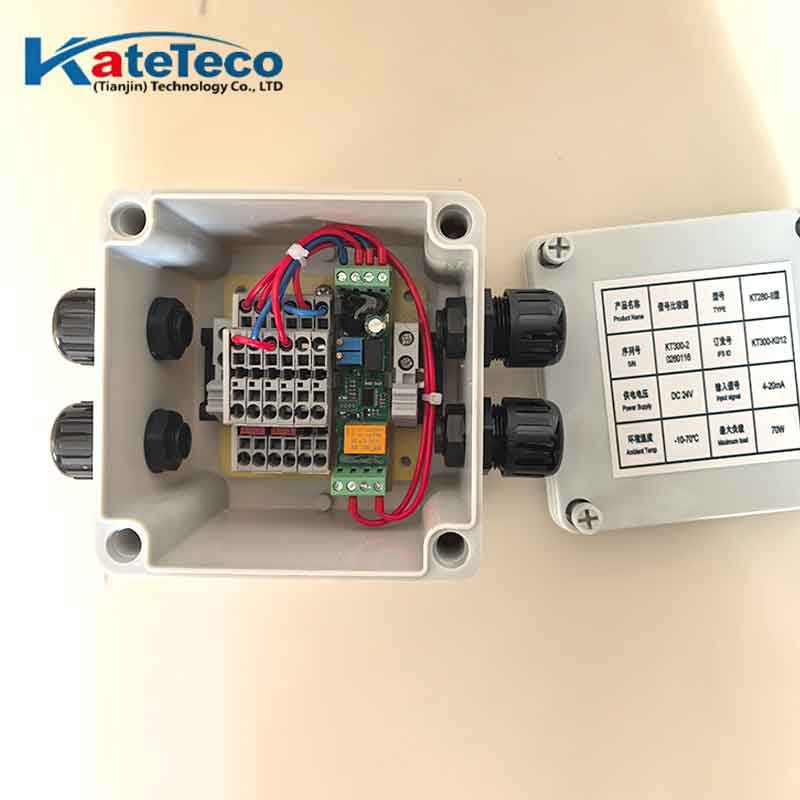
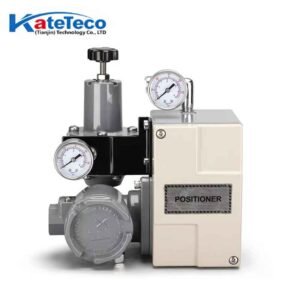
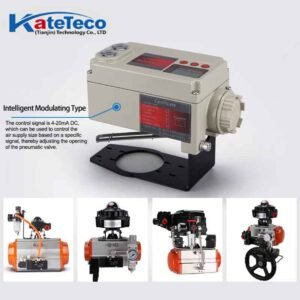
Control valves play a critical role in process control systems. Their normal operation requires the system to provide air supply, power supply, and signal supply, which are fundamental guarantees for proper valve function. Given their importance in the system, it is required that these three supplies be provided correctly and continuously to the control valve. However, in practice, systems cannot guarantee 100% error-free and continuous provision of these three supplies. Therefore, corresponding protective measures need to be implemented at the control valve end, namely adding a three-break protection circuit for the control valve. This three-break lock controller is designed specifically to achieve this function.
I. Main Technical Parameters
Rated Voltage: DC24V (AC220V optional)
Input Signal: 4~20mA
Minimum Input Current: 3.2mA
Maximum Load Power: 70W
Action Time: Adjustable 0-99S (if required)
II. Working Principle
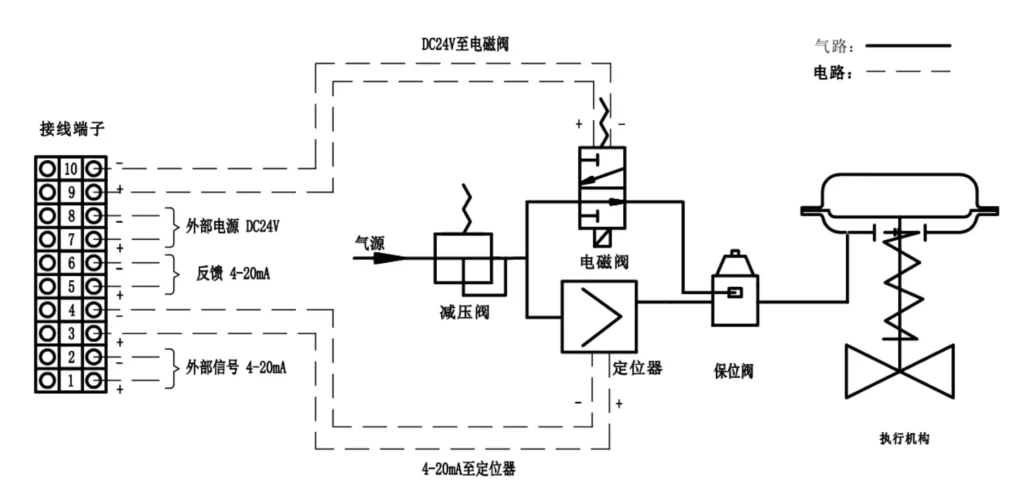
Typical Three-Break Lock Electrical Schematic Diagram
This three-break lock controller must be used in conjunction with a 2-position 3-way solenoid valve, a positioner, and a lock valve. The specific principle is to control the connection and disconnection of the pneumatic actuator’s air inlet port via the solenoid valve controlling the control port of the lock valve, thereby achieving the locking purpose.
Air Supply Loss Lock: When the external air supply is lost, the control port of the lock valve depressurizes, causing the lock valve to actuate and cut off the connection between the actuator’s air inlet port and external accessories, achieving the locking purpose.
Power Loss Lock: When the external power supply is lost, the solenoid valve de-energizes, causing the lock valve’s control port to depressurize. The lock valve then actuates, cutting off the connection between the actuator’s air inlet port and external accessories, achieving the locking purpose.
Signal Loss Lock: When the external signal is lost, the comparator calculates and compares, cutting off the power to the solenoid valve. This de-energizes the solenoid valve, causing the lock valve’s control port to depressurize. The lock valve then actuates, cutting off the connection between the actuator’s air inlet port and external accessories, achieving the locking purpose.
KT300 Series Valve Signal Comparator
III. Operating Instructions
Determine whether short-circuiting is necessary based on the type of analog signal (consult our company’s technical personnel).
Modular power supply design allows adjusting the comparator to a suitable trigger point by modifying the resistance value of the blue potentiometer according to the required comparison current signal size.
Adjust the relay control circuit recovery time based on actual site requirements to prevent oscillation in the control circuit (this function is optional).
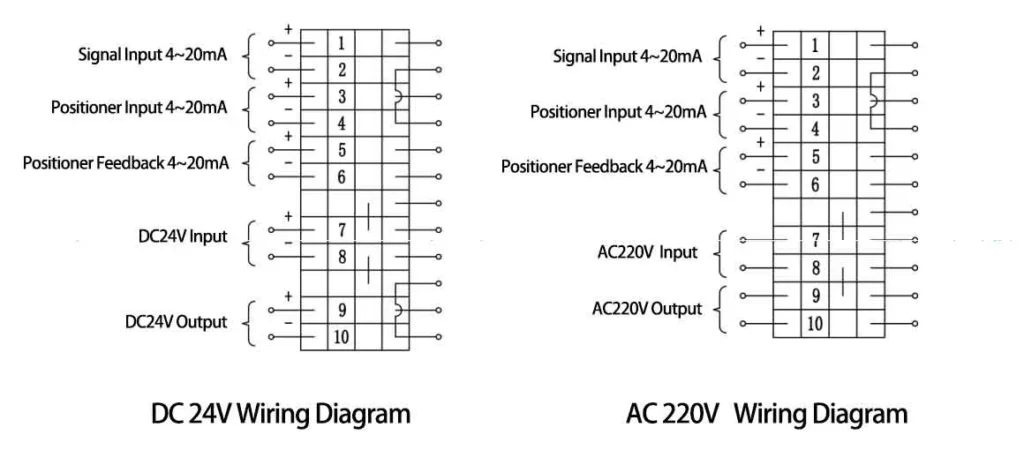
IV. Wiring Diagram
V. Model Designation
KT300-1 Type AC220V Non-Explosion-Proof Standard Type
KT300-G1 Type AC220V Non-Explosion-Proof Isolated Type
KT300-2 Type DC24V Non-Explosion-Proof Standard Type
KT300-G2 Type DC24V Non-Explosion-Proof Isolated Type
KT300-3 Type AC220V Increased Safety Explosion-Proof Type
KT300-G3 Type AC220V Increased Safety Explosion-Proof Isolated Type
KT300-4 Type DC24V Increased Safety Explosion-Proof Type
KT300-G4 Type DC24V Increased Safety Explosion-Proof Isolated Type
KT300-5 Type AC220V Flameproof Type
KT300-G5 Type AC220V Flameproof Isolated Type
KT300-6 Type DC24V Flameproof Type
KT300-G6 Type DC24V Flameproof Isolated Type
KT280-1 Type AC220V Non-Explosion-Proof Standard Type (Plastic Enclosure)
KT280-G1 Type AC220V Non-Explosion-Proof Isolated Type (Plastic Enclosure)
KT280-2 Type DC24V Non-Explosion-Proof Standard Type (Plastic Enclosure)
KT280-G2 Type DC24V Non-Explosion-Proof Isolated Type (Plastic Enclosure)